
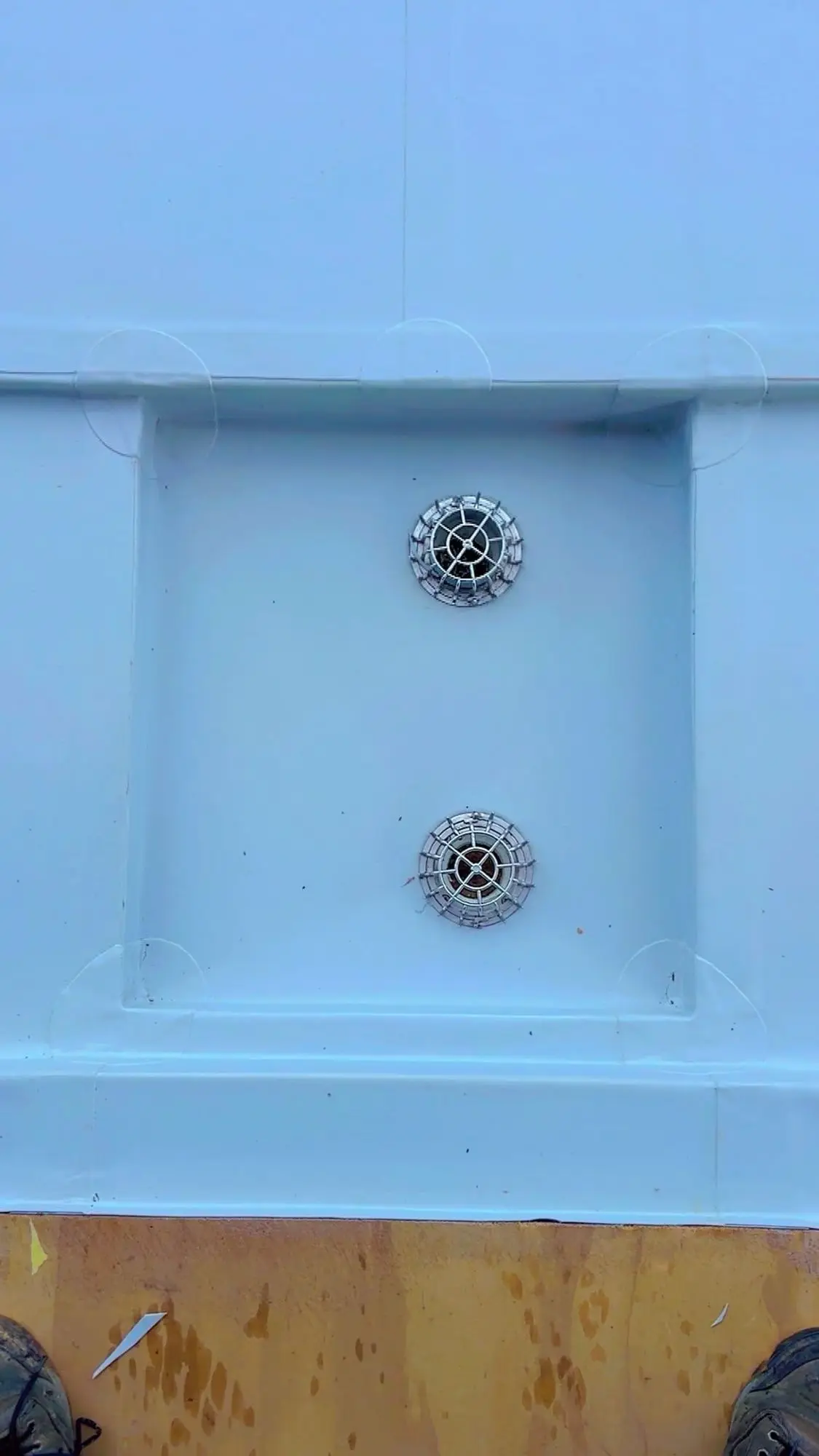
In ten years of chasing leaks across Auckland, almost none of them have been a hole in the middle of a roof. The membrane out in the open field does its job. It is the junctions that fail.
There are four of them, and if you know what to look at you can check three yourself from a ladder.
1. Upstands that were never taken high enough
An upstand is where the membrane turns up against a wall, a parapet or a door threshold. It has to be high enough that water sitting on the roof during a heavy downpour cannot get over the top of it.
The rule of thumb is 100mm minimum above the finished surface, and more where the roof is large or the outlets are undersized, because that is where the water builds up before it drains. A lot of older roofs were done at 50mm, or had a deck built over them later that effectively lowered the upstand.
2. Outlets that are blocked or too small
Every flat roof needs enough outlet capacity for the area it collects, plus an overflow so that a blocked outlet does not turn the roof into a pond.
Clearing outlets before winter is the single highest-value thing a homeowner can do for a flat roof, and it takes ten minutes. If you have an internal gutter, clear that too.
3. Penetrations that were sealed rather than collared
Every pipe, flue, vent and conduit through a roof is a hole. The quick approach is a rubber boot and a bead of sealant, which works until UV degrades the rubber.
The durable approach is a collar that becomes part of the roof surface, welded into the membrane so that water runs over the top of the detail rather than being held out by a seal.
4. Seams that were glued instead of welded
On a modern TPO or torch-on system, seams are heat-fused so that the join is as strong as the sheet itself. On older systems and on cheap installs they are glued, and adhesive has a service life measured in years rather than decades.
You can often see this one: a glued seam that is starting to go will show a fine dark line where dirt has worked into the opening edge.
What to do if you find one
Photograph it and send it to us. Most of these are genuine repairs, particularly if the membrane itself is still in good condition, and a repair is a much smaller job than people expect.
The inspection is free either way.